


Stablecoins are no longer just digital cash sitting idly on exchanges—they are evolving into active, yield-generating capital moving across multiple blockchains. The year 2025 marks a turning point for Circle, the issuer of USDC and EURC, as its total supply surged to an impressive $75 billion. This expansion is being absorbed by emerging networks like Solana, Base, and Arbitrum, each playing a key role in reshaping the decentralized finance (DeFi) landscape.
A Record Year for Circle’s Stablecoins
According to data from Token Terminal, Circle’s USDC and EURC have together reached over 35 million holders, doubling since the start of 2025. This growth highlights not just a rise in passive adoption but a fundamental shift in how stablecoins are used across blockchains. Ethereum continues to serve as the primary base layer, but the real story lies in how Layer-2 (L2) ecosystems and alternative chains are absorbing this expanding liquidity.
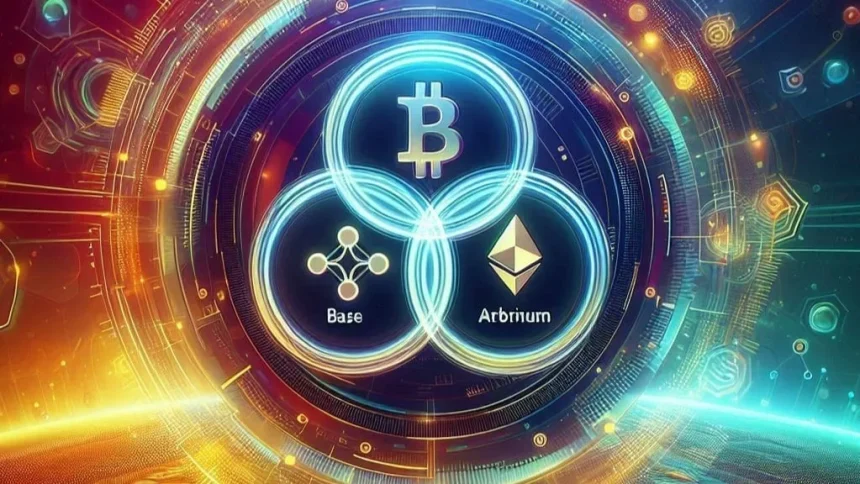
Solana, Base, and Arbitrum have emerged as standout destinations for new USDC distribution. Their scalability, low transaction fees, and developer-friendly environments make them ideal for both users and protocols seeking faster settlement and cheaper execution. The data clearly shows a surge in user adoption across these chains, with Base, in particular, registering one of the steepest increases in new stablecoin users.
Ethereum Still Dominates, But L2s Are Catching Up
Despite the rise of competing ecosystems, Ethereum remains the largest settlement network for stablecoins, hosting over $184 billion in total supply—up by more than $100 billion since January 2024. However, this dominance now coexists with a growing presence of other networks.
Unlike the early stablecoin era, where Ethereum was the exclusive hub for issuance and transactions, the 2025 expansion has distributed liquidity more evenly. Solana, Base, Arbitrum, and Polygon now account for a meaningful share of Circle’s total supply. This signals a multi-chain future for stablecoins, where users can move capital seamlessly between different blockchains without compromising speed or cost.
Interestingly, the expansion of Circle’s stablecoins on these newer networks has coincided with rising transaction throughput. On Ethereum, stablecoin transfer volume is increasing in tandem with supply growth. This contrasts with the 2021–2023 period when large stablecoin supplies often sat dormant, used mostly as storage or collateral on centralized platforms.
The Rise of Active On-Chain Capital
The surge in USDC adoption across multiple blockchains suggests that stablecoins are entering a new era—one defined by active use and velocity rather than passive holding. As Circle’s supply expanded, on-chain data indicated that stablecoins were being used more frequently for trading, liquidity provision, and yield farming.
In simple terms, capital is now circulating rather than resting. On-chain activity metrics show that the new 35 million stablecoin holders are participating in transactions, DeFi lending, and real-world asset settlements. This dynamic growth shows how stablecoins are transitioning into functional units of on-chain finance, facilitating everything from cross-border transfers to decentralized payments.
The move towards active capital has broader implications. Stablecoins are increasingly viewed as a bridge between traditional finance and decentralized ecosystems. They are used not only for speculative trading but also for real-world applications such as remittances, payroll, and tokenized asset settlements. This transition aligns with Circle’s long-term goal of positioning USDC as the backbone of an open, programmable financial system.
Solana, Base, and Arbitrum: Engines of the Next Wave
Each of the leading networks—Solana, Base, and Arbitrum—plays a distinct role in this transformation.
Solana, known for its high-speed and low-cost transactions, has become a prime venue for payment applications and high-frequency trading. The network’s recent integrations with major DeFi platforms have accelerated USDC’s movement, making it a hub for retail and institutional flows alike.
Base, an Ethereum Layer-2 developed by Coinbase, has quickly become a home for stablecoin transactions. Its integration within Coinbase’s ecosystem provides an easy entry point for users and institutions, bridging centralized exchanges and on-chain activity. Base’s user adoption curve for stablecoins has grown rapidly throughout 2025, suggesting strong retail participation.
Arbitrum, meanwhile, continues to attract DeFi projects that require scalability without sacrificing Ethereum’s security. Its compatibility with the Ethereum Virtual Machine (EVM) allows protocols to onboard liquidity effortlessly, supporting a healthy and growing share of USDC issuance.
Together, these ecosystems illustrate a clear trend—Circle’s growth is no longer Ethereum-first. The new distribution of stablecoin liquidity across multiple blockchains enhances interoperability and paves the way for broader decentralized finance adoption.
A New Market Cycle for Stablecoins
Beyond raw supply figures, what’s notable is how the nature of stablecoin adoption has evolved. From 2022 to 2023, growth in supply was often disconnected from usage; stablecoins were being minted but not actively used. Now, the relationship between supply and transfer volume has tightened, indicating more organic, utility-driven growth.
The acceleration of stablecoin transfers suggests that new capital is flowing into the ecosystem not just for speculation, but for productive use. Businesses, DeFi protocols, and users alike are leveraging stablecoins as a reliable medium of exchange and yield-bearing asset.
This dynamic is reshaping liquidity across DeFi platforms. As stablecoins become more embedded in decentralized infrastructure, they provide the foundation for lending markets, derivatives trading, and tokenized real-world assets.
The Broader Impact: From Idle Capital to Digital Dollars in Motion
Stablecoins are evolving from being static reserves into engines of liquidity that power the digital economy. Circle’s $75 billion expansion and the doubling of its user base reflect the rapid institutionalization of stablecoin finance.
With 35 million holders actively using stablecoins across multiple blockchains, 2025 may go down as the year stablecoins transitioned from passive digital dollars to dynamic financial instruments—circulating, earning, and interacting across networks like Solana, Base, and Arbitrum.
The implications are vast: faster payments, global access to DeFi, and deeper liquidity pools. As more users embrace this multi-chain reality, stablecoins are likely to become the core building block of the next wave of blockchain finance.
Post Views: 110