



- Part 1: The Call Debit Spread (The Bull Call Spread)
- How a Call Debit Spread is Constructed
- Why Trade a Bull Call Spread Instead of a Naked Call?
- Bull Call Spread: A Real-World Example
- Stop Guessing Market Direction. Find Perfect Entries.
- Part 2: The Put Debit Spread (The Bear Put Spread)
- How a Put Debit Spread is Constructed
- Why Trade a Bear Put Spread Instead of Shorting Stock?
- Bear Put Spread: A Real-World Example
- Part 3: Call Debit Spreads vs. Put Debit Spreads: The 4 Core Differences
- 1. Directional Bias and Market Environment
- 2. The Speed of Price Movement (Elevator vs. Escalator)
- 3. Volatility Skew (The Hidden Pricing Factor)
- 4. Dividend Risk and Early Assignment
- Level Up Your Spread Trading Strategies
- How to Choose Which Spread to Trade
- Step 1: Analyze the Broad Market Trend (The SPY & QQQ)
- Step 2: Identify Clear Technical Chart Patterns
- Step 3: Check Earnings Dates and Volatility
- Step 4: Look at the Greeks (Specifically Delta)
- Summary: A Tale of Two Directions
Welcome back to the TradingStrategyGuides.com Ultimate Series on Debit Spreads.
In our first installment, What is a Debit Spread? The Ultimate Beginner’s Guide, we introduced the foundational concept of this powerful, risk-defined options strategy. We covered how combining long and short options contracts can dramatically lower your upfront costs while mathematically capping your potential losses.
Now, it is time to get tactical. As an options trader, your primary job is to diagnose the market direction and deploy the exact right strategy for that specific environment. When trading debit spreads, you have two primary weapons in your arsenal: Call Debit Spreads and Put Debit Spreads.
While both strategies share the exact same structural DNA—buying an option closer to the money and selling an option further out of the money to reduce cost—they serve two entirely opposite market outlooks. One is your sword for raging bull markets; the other is your shield and spear for crushing bear markets.
In this comprehensive, deep-dive guide, we will break down the mechanics, use cases, and core differences between Call Debit Spreads and Put Debit Spreads. By the end of this article, you will know exactly when to pull the trigger on each, how they behave differently under the hood, and how professional traders use them to extract consistent profits regardless of which way the market is trending.
Let’s dive into the charts and the mechanics.
Part 1: The Call Debit Spread (The Bull Call Spread)
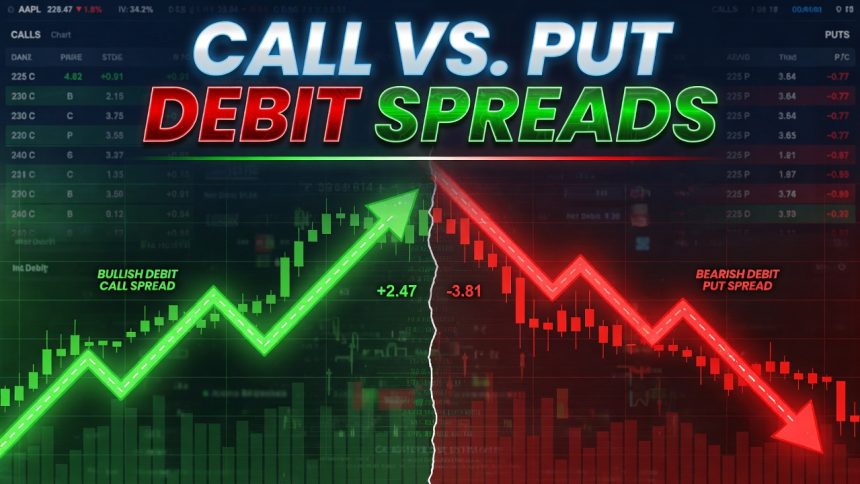
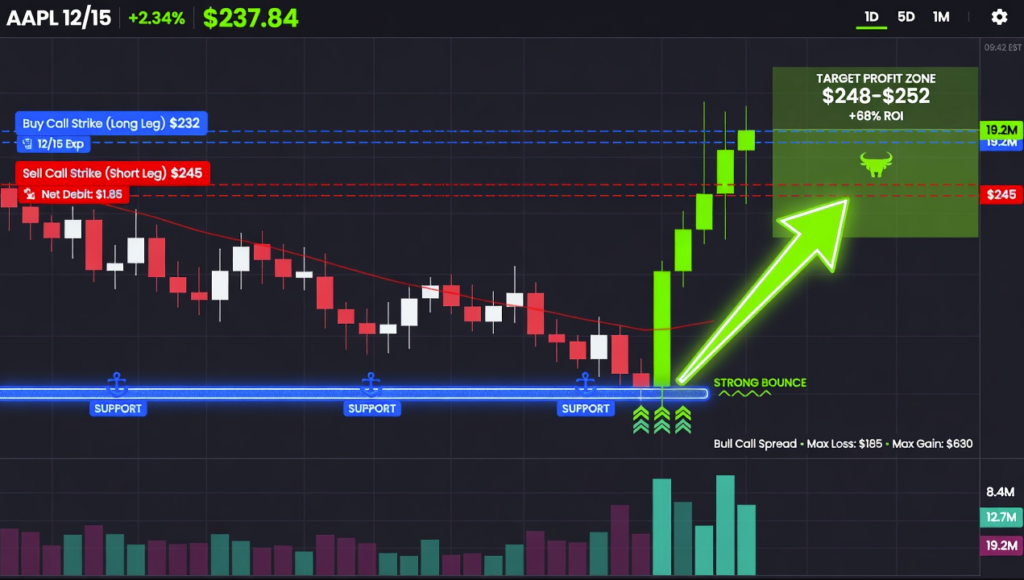
The Call Debit Spread, most commonly referred to by options traders as the Bull Call Spread, is a vertical options strategy designed strictly for bullish market conditions. You deploy this strategy when your technical analysis tells you that the underlying stock, ETF, or index is preparing to rise in price, but you want to tightly limit your upfront capital risk and protect yourself against unexpected market downturns.
How a Call Debit Spread is Constructed
A Call Debit Spread consists of two legs, both utilizing Call options in the exact same expiration cycle:
- The Long Leg: You BUY a Call option (typically At-The-Money or slightly In-The-Money). This gives you the right to buy the stock at a specific price.
- The Short Leg: You simultaneously SELL a Call option with a higher strike price (typically Out-Of-The-Money). This obligates you to sell the stock at a higher price if assigned.
Because the Call option you are buying is closer to the current stock price, it is inherently more expensive than the Call option you are selling. Therefore, the premium you collect from the short leg only partially offsets the cost of the long leg. You pay a net debit to enter the trade from your brokerage account—hence the name “Debit Spread.”
Why Trade a Bull Call Spread Instead of a Naked Call?
Beginners often ask a very logical question: “If I think the stock is going up, why not just buy a regular Call option and keep all the upside for myself?” It’s a fair question, but naked long options carry three massive, often account-destroying risks: high upfront capital costs, aggressive time decay (known as Theta), and intense vulnerability to dropping implied volatility (known as Vega). By turning that naked call into a structured Bull Call Spread, you drastically alter your risk profile in your favor:
- Cheaper Entry: Selling the higher strike call finances a significant portion of your long call. This makes the trade much cheaper to enter, allowing you to risk less capital per trade or trade more expensive, high-quality stocks like tech mega-caps.
- Neutralizing Time Decay: Options are decaying assets. When you buy a naked call, time is your enemy. But in a spread, the time decay on the short call works in your favor, mathematically offsetting the time decay on the long call you bought. You buy yourself time.
- Lower Breakeven Point: Because you paid less for the trade overall, the stock doesn’t need to rise as far for you to become profitable at expiration. You are essentially lowering the hurdle the stock needs to jump over for you to get paid.
The trade-off for these amazing benefits? Your upside is strictly capped. If the stock explodes to the moon, you will not make any additional money past your short strike. But as professional traders know, consistent trading is about managing risk and taking base hits, not blindly swinging for lottery-ticket home runs.
Bull Call Spread: A Real-World Example
Let’s put some numbers to this to make the concept crystal clear.
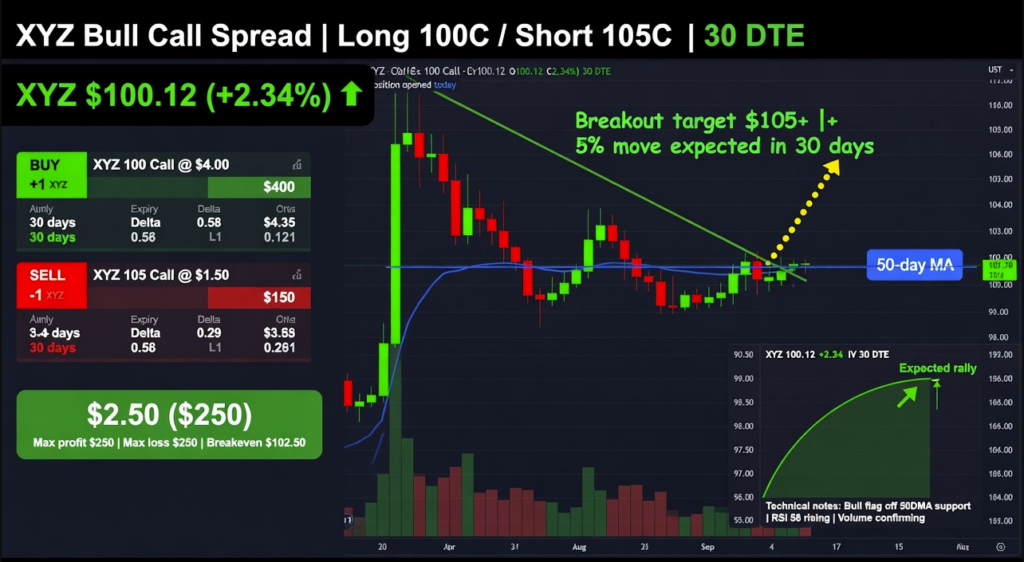
Imagine Stock XYZ is currently trading at $100 per share. You have done your technical analysis, noticed a beautiful bull flag pattern bouncing off the 50-day moving average, and believe the stock is going to break out and rally to $105 or higher over the next 30 days.
- Leg 1: You BUY the $100 strike Call option for $4.00 (which costs $400 total since standard options control 100 shares).
- Leg 2: You SELL the $105 strike Call option for $1.50 (which brings $150 of premium back into your account).
The Core Math:
- Net Debit Paid: $4.00 – $1.50 = $2.50 ($250 per contract). This is your total out-of-pocket cost.
- Spread Width: $105 – $100 = $5.00.
The Outcomes at Expiration:
- Max Risk (Loss): Your absolute maximum loss is the net debit paid. If XYZ stock drops or simply stays below $100 by expiration, both options expire completely worthless. You lose $250. Even if the stock drops to $0, you only lose $250.
- Max Profit: Your max profit is the width of the spread minus the net debit paid. ($5.00 – $2.50 = $2.50). If the stock closes at or above $105 at expiration, your spread achieves its maximum value of $5.00. You subtract your $2.50 cost, and you make a net profit of $250.
- Breakeven Point: Long Strike + Net Debit ($100 + $2.50) = $102.50.
In this scenario, you are risking $250 to make $250—a perfect 1:1 risk-to-reward ratio. Notice that your breakeven is $102.50. If you had just bought the naked $100 call for $4.00, your breakeven would have been $104.00! The spread gives you a significantly higher probability of success by lowering that breakeven hurdle by $1.50.
Stop Guessing Market Direction. Find Perfect Entries.
The secret to choosing between a Call Debit Spread or a Put Debit Spread? Knowing exactly where the institutional Support and Resistance levels are hiding on the chart.
The Magnizone Indicator automatically plots highly accurate, institutional-grade support and resistance zones directly on your chart. When price bounces off a Magnizone support, you fire a Bull Call Spread. When it heavily rejects a Magnizone resistance, you fire a Bear Put Spread. It takes the emotion and guesswork completely out of the equation.
Get the Magnizone Indicator and Time Your Spreads Perfectly!
Part 2: The Put Debit Spread (The Bear Put Spread)
The Put Debit Spread, commonly known in the industry as the Bear Put Spread, is the exact mirror image of the Call Debit Spread. This is a vertical options strategy designed exclusively for bearish market conditions. You deploy this strategy when you expect the underlying asset to fall in price, allowing you to profit handsomely from a market decline with strictly limited, sleep-at-night risk.
How a Put Debit Spread is Constructed
A Put Debit Spread consists of two legs, both utilizing Put options in the same expiration cycle:
- The Long Leg: You BUY a Put option (typically At-The-Money or slightly In-The-Money). This gives you the right to sell the stock at a specific price, meaning it gains value as the stock falls.
- The Short Leg: You simultaneously SELL a Put option with a lower strike price (typically Out-Of-The-Money). This obligates you to buy the stock at a lower price if assigned.
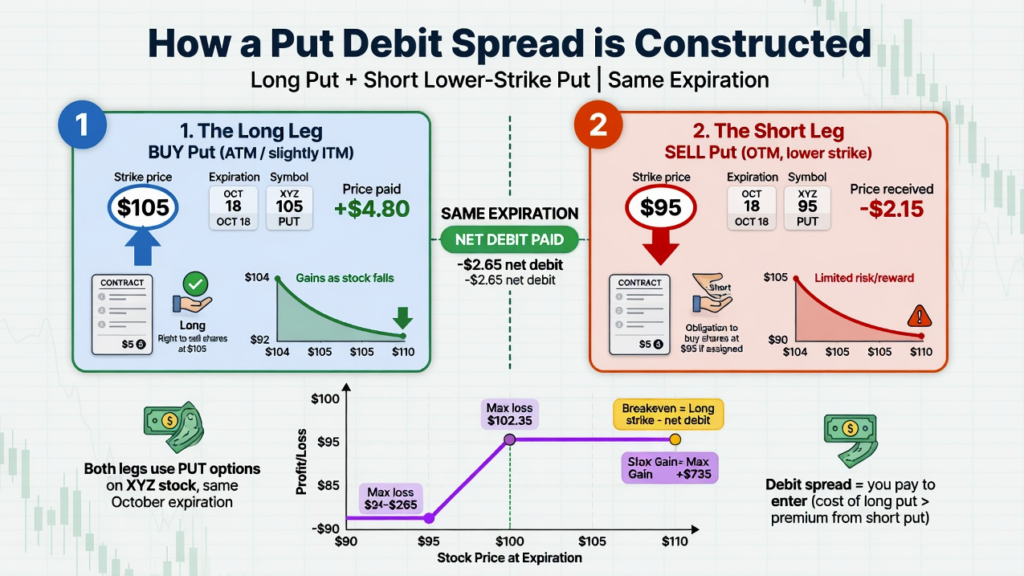
Just like the call spread, the put option you are buying has a higher premium than the put option you are selling because it gives you the right to sell the stock at a higher, more favorable price. The premium collected from the short put reduces the cost of your long put, resulting in a net debit.
Why Trade a Bear Put Spread Instead of Shorting Stock?
Shorting stock outright is incredibly dangerous for retail traders. When you short a stock, your potential losses are mathematically infinite—there is absolutely no ceiling on how high a stock’s price can go (just ask anyone who shorted GameStop or AMC during the 2021 meme stock craze).
Furthermore, shorting requires margin accounts, exposes you to hefty borrowing fees, and carries the constant, looming threat of a margin call from your broker if the trade goes against you.
A Bear Put Spread solves all of these systemic problems:
- Absolutely Defined Risk: You cannot lose a single penny more than the net debit you paid to enter the trade. Even if the stock gets bought out and gaps up 500% overnight, your maximum risk is strictly capped.
- High Leverage, Low Capital: You can control 100 shares of downside price action for a fraction of the cost of shorting 100 shares of stock, freeing up your capital for other trades.
- No Borrowing Fees or Margin Calls: You aren’t borrowing physical shares from a broker, so you aren’t paying hard-to-borrow fees, and a standard options account won’t issue a margin call on a debit spread.
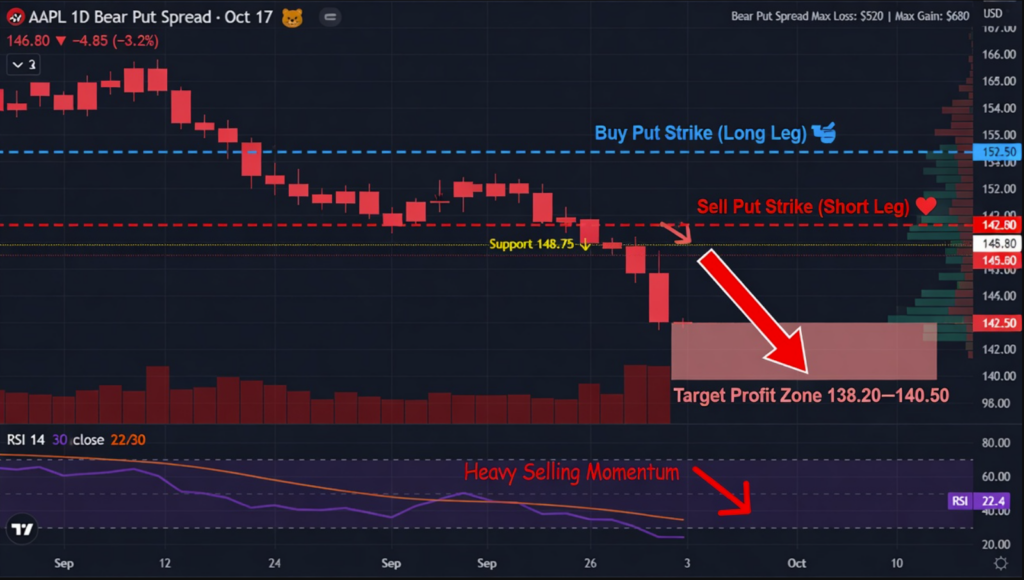
Bear Put Spread: A Real-World Example
Let’s look at the mechanics of a bearish setup to see how powerful this can be during a market sell-off.
Imagine Stock ABC is currently trading at $50 per share. Your technical indicators flash a massive sell signal—perhaps a head-and-shoulders pattern breaking the neckline—and you believe the stock is going to drop heavily to $45 or lower within the next three weeks.
- Leg 1: You BUY the $50 strike Put option for $2.50 ($250 total).
- Leg 2: You SELL the $45 strike Put option for $0.50 ($50 total).
The Core Math:
- Net Debit Paid: $2.50 – $0.50 = $2.00 ($200 per contract). This is your total out-of-pocket cost.
- Spread Width: $50 – $45 = $5.00.
The Outcomes at Expiration:
- Max Risk (Loss): Your maximum loss is the net debit paid. If ABC stock rallies unexpectedly and stays above $50 by expiration, both put options expire worthless. You lose $200, and not a penny more.
- Max Profit: Your max profit is the spread width minus the net debit. ($5.00 – $2.00 = $3.00). If the stock drops and closes at or below $45 at expiration, your spread maximizes its value at $5.00. You subtract your $2.00 cost, and you make a net profit of $300.
- Breakeven Point: Long Strike – Net Debit ($50 – $2.00) = $48.00.
In this scenario, you are risking $200 to make a potential $300—a fantastic 1:1.5 risk-to-reward ratio. You simply need the stock to drop below $48.00 to start seeing green at expiration, a much easier target than needing it to drop to $47.50 if you had bought the naked put alone.
Part 3: Call Debit Spreads vs. Put Debit Spreads: The 4 Core Differences
At face value, Call Debit Spreads and Put Debit Spreads seem like just two sides of the exact same coin. The basic math equations are identical; only the direction of the underlying stock changes. However, when you start trading these strategies in real, live market environments, several nuanced differences emerge that professional options traders must deeply understand.
1. Directional Bias and Market Environment
The most obvious difference is the direction.
- Call Debit Spreads require the underlying asset to go UP. They thrive in roaring bullish markets, sector breakouts, following positive earnings reports, or during macroeconomic quantitative easing.
- Put Debit Spreads require the underlying asset to go DOWN. They thrive in brutal bear markets, sector breakdowns, recessionary fears, inflationary panics, or after a stock loses major technical support.
Pro Tip: “The trend is your friend.” Never try to force a Call Debit Spread in a glaring bear market just because the option premiums look cheap. Always align your spread direction with the broader market trend.
2. The Speed of Price Movement (Elevator vs. Escalator)
There is a famous, time-tested Wall Street adage: “Stocks take the escalator up, but they take the elevator down.”
Bullish trends tend to be slow, grinding, and methodical. Buyers slowly accumulate shares over weeks and months. Bearish trends, however, tend to be violent, fast, and driven by pure, unadulterated panic. When fear enters the market, selling pressure accelerates rapidly as institutions dump shares.
Because of this psychological dynamic, Put Debit Spreads often hit their maximum profit targets much faster than Call Debit Spreads. If you are trading Bear Put Spreads, you must be prepared to manage your trades quickly. Violent dead-cat bounces (short squeezes) can erase your bearish profits just as fast as the initial drop created them.
3. Volatility Skew (The Hidden Pricing Factor)
This is a critical, advanced concept that separates the amateurs from the pros. In the equities market (stocks and stock indices like the S&P 500), there is an invisible force called Volatility Skew (specifically, “Put Skew”).
Because massive institutional investors and mutual funds hold trillions of dollars in long stock, they constantly buy Out-Of-The-Money Put options to insure their portfolios against catastrophic market crashes. This massive, relentless demand for Puts drives up their implied volatility. Therefore, Put options are inherently more expensive than Call options that are an equal distance away from the current stock price.

How does this affect your Debit Spreads?
- When you buy a Bear Put Spread, you are generally paying a higher premium for your long Put because of the skew, but you are also collecting an inflated premium for the OTM Put you sell. Often, Put spreads might need to be structured slightly wider to achieve the exact same 1:1 risk/reward ratio as a Call spread.
- When you buy a Bull Call Spread, you are generally dealing with lower implied volatility. Calls are generally cheaper, which can sometimes make funding the spread highly efficient, but it also means the OTM call you sell won’t fetch quite as much premium.
4. Dividend Risk and Early Assignment
When trading individual stocks that pay high quarterly dividends, Call Debit Spreads carry an early assignment risk that Put Debit Spreads generally do not.
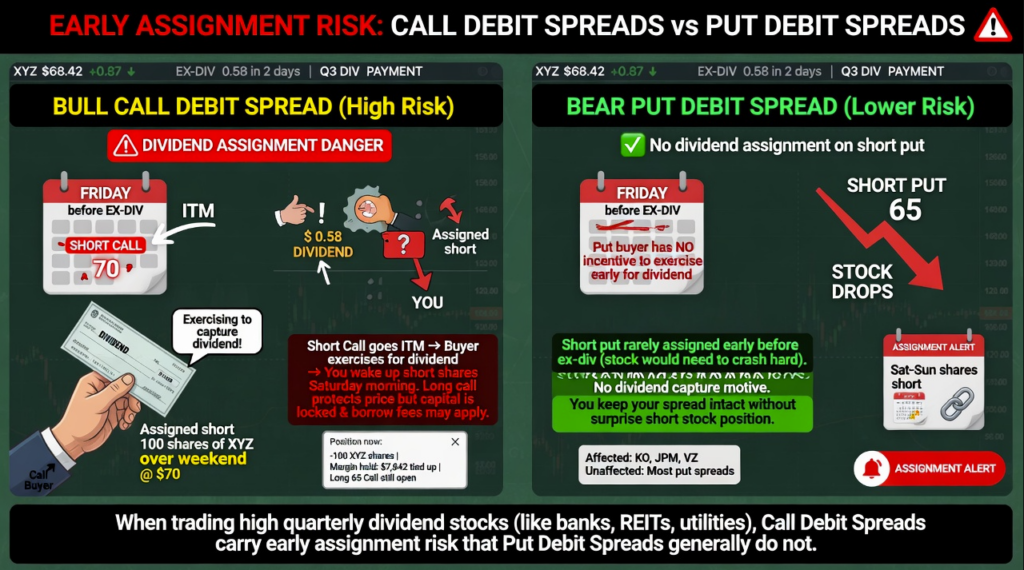
If your short Call option in a Bull Call Spread goes In-The-Money right before an ex-dividend date, the buyer of that call might exercise it early to capture the dividend payment. This can result in you being assigned short shares of the stock over the weekend. While your long call still protects you mathematically from infinite risk, early assignment is a massive logistical headache that ties up capital and stresses out retail traders. Bear Put Spreads rarely face this specific dividend-related assignment risk on the short side.
Level Up Your Spread Trading Strategies
Debit spreads are just the beginning. If you want to learn how professional traders structure unique options strategies to generate consistent income and protect their capital, you need to check out Layered Options.
Discover how to stack your options trades for maximum probability and drastically reduced risk. Stop guessing with single directions and start trading with a multi-layered mathematical edge.
Click Here to Master Layered Options Now!
How to Choose Which Spread to Trade
Now that you understand the mechanics and the core differences, how do you actually decide which strategy to deploy on any given Tuesday morning? You should never, ever randomly guess whether a stock will go up or down. You need a systematic approach.
Here is a simple, highly effective framework for choosing your directional weapon:
Step 1: Analyze the Broad Market Trend (The SPY & QQQ)
Before looking at a single individual stock chart, look at the overall market environment. Are the S&P 500 (SPY) and the Nasdaq 100 (QQQ) making higher highs and higher lows? Are they trading above their 50-day and 200-day moving averages?
- If the broader market is aggressively bullish, your highest probability trades will be Call Debit Spreads. A rising tide lifts all boats.
- Conversely, if the major indices are plunging below moving averages and fear is high, switch your bias immediately to Put Debit Spreads.
Step 2: Identify Clear Technical Chart Patterns
Once you have your broader market bias, look for individual stocks showing confirming patterns.
- Bullish Patterns (Call Debit Spread Triggers): Look for Bull flags, ascending triangles, double bottoms, cup-and-handle patterns, or a clean bounce off a major support zone or moving average.
- Bearish Patterns (Put Debit Spread Triggers): Look for Bear flags, descending triangles, head and shoulders patterns, double tops, or a sharp, heavy-volume rejection at a major resistance zone.
Step 3: Check Earnings Dates and Volatility
Never enter a standard debit spread blindly without checking when the company reports earnings. If a stock is about to announce earnings in two days, implied volatility will be exceptionally high. In high-volatility environments, debit spreads are generally superior to naked options because the short leg protects you from the massive “IV Crush” that happens the day after earnings are announced. (We will cover the specific nuances of trading earnings with debit spreads much later in this ultimate series).
Step 4: Look at the Greeks (Specifically Delta)
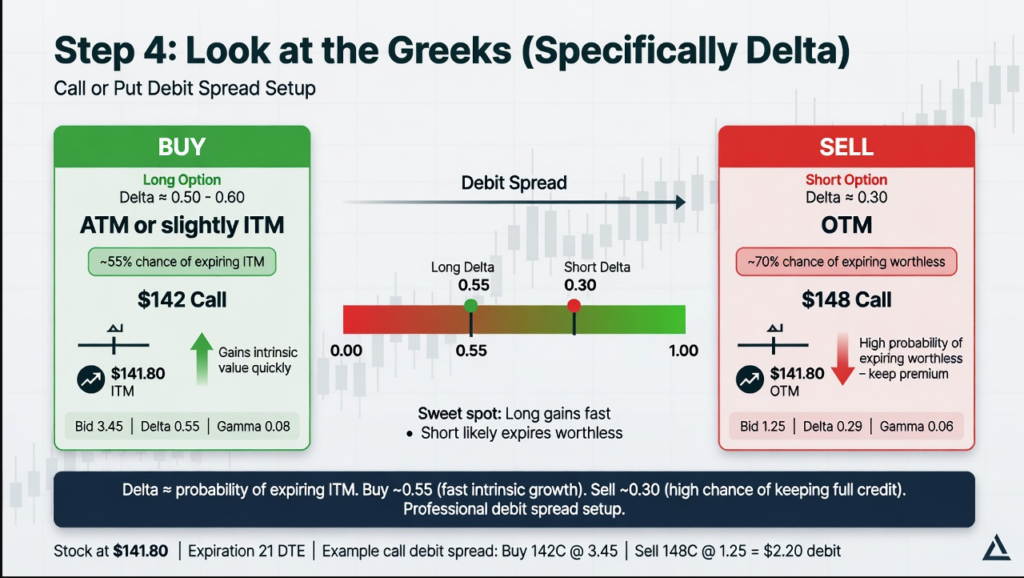
When selecting your specific strike prices for either a call or put debit spread, professional traders look at the Delta of the options. Delta tells you the probability of that option expiring In-The-Money.
A highly common professional setup is to buy an option with a Delta around .50 to .60 (At-The-Money or slightly ITM) and sell an option with a Delta around .30 (Out-Of-The-Money). This sweet spot ensures your long option gains intrinsic value quickly if the stock moves in your direction, while the option you sold has a high probability of expiring worthless, allowing you to keep the premium.
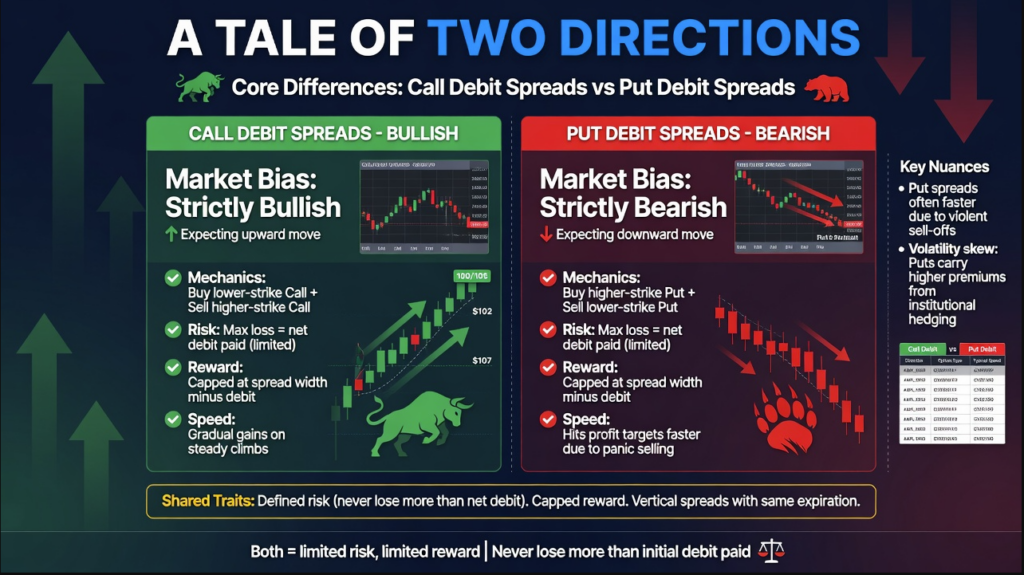
Summary: A Tale of Two Directions
Let’s do a quick, comprehensive recap of the core differences to cement your knowledge:
- Market Bias: Call Debit Spreads are strictly for bullish traders expecting an upward move; Put Debit Spreads are for bearish traders expecting a downward move.
- The Mechanics: Call spreads involve buying and selling Calls. Put spreads involve buying and selling Puts.
- Risk vs. Reward: Both strategies offer strictly defined risk (your max loss is the net debit paid) and capped reward (the spread width minus the net debit). You can never lose more than your initial investment.
- Speed of the Trade: Put spreads tend to hit profit targets faster due to the violent nature of market sell-offs (panic selling).
- Options Pricing: Put spreads often contend with volatility skew, meaning Puts may carry slightly higher premiums across the board compared to Calls due to institutional hedging.
Mastering both the Call Debit Spread and the Put Debit Spread is a massive milestone. It transforms you from a one-dimensional, “hopes-it-goes-up” trader into a versatile, dangerous market operator. You no longer have to fear market crashes or economic downturns—with a Put Debit Spread in your toolkit, a market crash simply becomes an opportunity for massive, risk-defined profit. And when the dust settles and the bull market returns, your Call Debit Spreads will be ready and waiting to ride the wave upward.
What’s Next in the Ultimate Debit Spread Series?
Now that you know the difference between the bullish and bearish variations of this strategy, it is time to look even closer under the hood. To be consistently profitable for years to come, you must master the mathematical mechanics of these trades.
In our third article of this series, The Mechanics of a Debit Spread: Max Profit, Max Loss, and Breakeven Explained, we are going to dive deep into the exact formulas and math that govern every single debit spread you will ever place. We will teach you how to calculate your exact risk-to-reward ratios in seconds so you never enter a bad trade again.
Stay tuned, and keep your risk defined
Join the Find Better Trades Community!
Get more free strategies, indicators, and trade ideas across all our channels: